
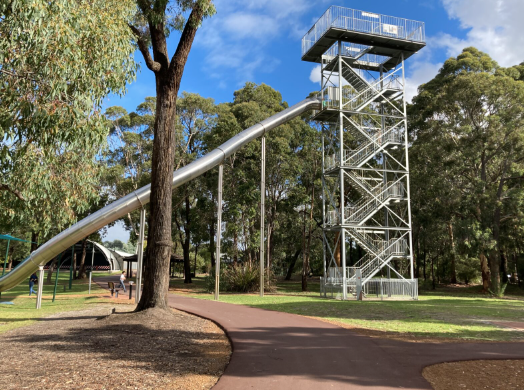
The Manjimup Linear Path is a high-quality, sealed rail trail that forms the north–south ‘spine’ of Manjimup, offering a safe and scenic way to explore the town.
Stretching approximately 7.5km return (around 4km one way), the trail runs from Manjimup Heritage Park near Graphite Road to the southern edge of town at Seven Day Road. Built along a disused section of the Northcliffe Branch Railway (also known as the Picton to Northcliffe line), the path follows a gentle, flat alignment, making it accessible for all ages and abilities.
Classified as a Class 1 trail, the Linear Path is ideal for walking, cycling, prams, wheelchairs and scooters, and is also dog friendly. The full return journey takes around 1 hour 20 minutes on foot, or approximately 40 minutes one way.
More than just a standalone trail, the Linear Path connects with the Manjimup to Deanmill Heritage Trail and the King Jarrah Path, creating a broader 13km car-free recreational network. Together, these trails link many of Manjimup’s key attractions, providing an easy and enjoyable way to move between them.
Nearby Attractions
The trail conveniently connects to several popular local spots, including:
- Manjin Park, featuring a playground, skate park, exercise equipment and BBQ facilities
- Manjimup Heritage Park, home to the Manjimup Historic Hamlet, State Timber Museum, Power Up Electricity Museum, and a family-friendly playground with a 17m slide
Traditional Owners
Rail Trails Australia acknowledges the Murrum people of the Noongar Nation as the traditional custodians of the land and waterways on which this trail is located.
Development and Future
The Manjimup Linear Path officially opened in 2018 as part of the Manjimup Town Centre Revitalisation project. Future plans outlined in the Shire of Manjimup’s 2017–2027 Local Bicycle and Footpath Plan include potential extensions south to Pemberton and north to Bridgetown.
Rail Line History
Construction of the Picton to Northcliffe railway began in 1887, reaching Manjimup in 1911 and extending to Northcliffe by 1933. The railway played a key role in the region’s development, particularly during the Group Settlement Scheme of the 1920s. The line ceased operations in the early 2000s, with sections now repurposed for recreational use.